

Neuromorphic Computing: The Next Frontier in Tech Innovation Redefining How Machines Think
Something unusual is happening at the edge of computing research. Engineers are no longer just building faster chips — they're building chips that think differently. Neuromorphic computing borrows the architecture of the human brain to process information in ways that conventional silicon simply cannot match. And given where traditional computing is heading, the timing couldn't be more significant.
What Is Neuromorphic Computing?
Neuromorphic computing is a hardware and software approach that mimics the structure and function of biological neural networks to process information. Rather than executing instructions in rigid sequential steps, neuromorphic systems use artificial neurons and synapses to communicate through electrical spikes — much like the brain does.
The term was coined by carver Mead in the late 1980s, but the field has accelerated sharply in the last decade. At its core, the idea is straightforward: the human brain runs on roughly 20 watts of power while outperforming any supercomputer at tasks like pattern recognition, sensory interpretation, and adaptive learning. Why not use that design as a blueprint?
This brain-inspired architecture represents a genuine paradigm shift — not an incremental upgrade to existing chips, but a fundamentally different computational model built around parallel, event-driven processing.
Why Traditional Computing Is Hitting a Wall
Conventional processors are running into hard physical and economic limits that no amount of engineering refinement can fully overcome. The core issue is the von Neumann bottleneck — the architectural separation between memory and processing that forces data to shuttle back and forth constantly, consuming energy and creating latency.
For decades, Moore's Law kept this manageable by doubling transistor density roughly every two years. But transistors are now approaching atomic scale. Shrinking them further yields diminishing returns, generates more heat per unit area, and drives fabrication costs to staggering heights. The free lunch is over.
Meanwhile, the demands on computing keep growing. AI workloads, real-time sensor fusion, autonomous systems — these applications need not just raw speed but efficient intelligence. That's a problem today's chips weren't designed to solve elegantly. Neuromorphic architecture addresses the bottleneck at the hardware level, not just through software optimization.
How Neuromorphic Chips Actually Work
Neuromorphic chips process information using Spiking Neural Networks (SNNs) — computational models where artificial neurons only fire when input crosses a threshold, just as biological neurons do. This event-driven approach is what makes them fundamentally different from conventional processors.
In a traditional CPU or GPU, every clock cycle triggers computation across the entire chip, whether data is changing or not. In a neuromorphic processor, computation only happens when a spike occurs. Most of the chip sits idle most of the time, consuming almost no power. When activity is sparse — as it often is in real-world sensory data — the energy savings are dramatic.
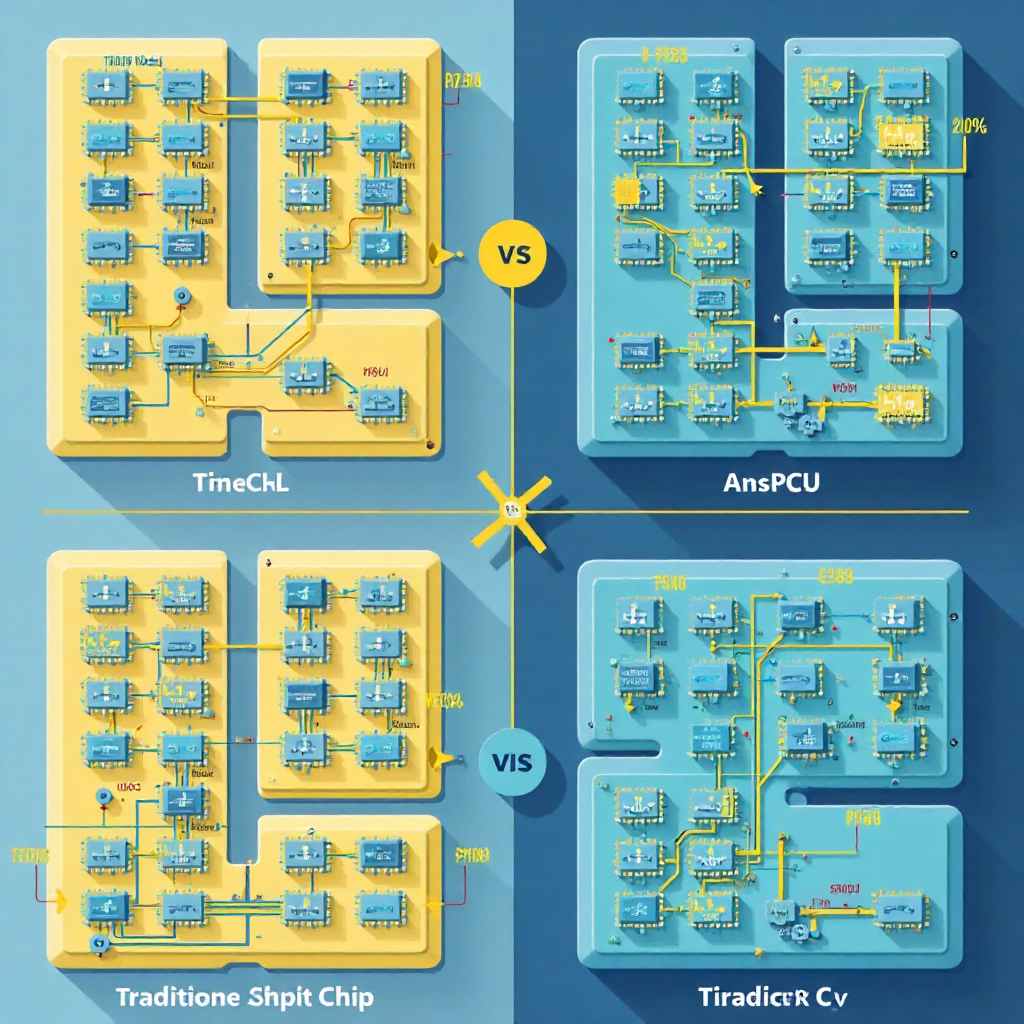
Intel's Loihi chip is one of the most studied reference-class examples of this approach. Loihi implements on-chip learning through spike-timing-dependent plasticity, allowing the processor to adapt to new patterns without being retrained from scratch on external hardware. It's not a commercial product in the consumer sense, but as a research platform it has demonstrated compelling capabilities in areas like odor recognition, optimization problems, and robotic control.
The asynchronous processing model also eliminates the need for a global clock signal — another source of wasted energy in conventional chips. Each neuron operates independently, firing when its local conditions are met. The result is a massively parallel system that scales gracefully with problem complexity.
Key Applications Shaping the Future
Neuromorphic technology's most compelling near-term applications cluster around scenarios where low power, real-time response, and adaptive learning all matter simultaneously. That's a profile that fits several high-growth domains.
- Autonomous vehicles and robotics: Processing visual and spatial data at the edge without relying on a cloud connection requires chips that are both fast and power-efficient. Neuromorphic processors can handle sensory fusion tasks — combining camera, lidar, and radar inputs — with far less energy than GPU-based systems.
- IoT and edge computing: Billions of connected devices need local intelligence. A neuromorphic chip embedded in a sensor can detect anomalies, recognize patterns, and trigger responses without sending raw data to a central server — reducing latency, bandwidth costs, and privacy exposure.
- Prosthetics and neural interfaces: Brain-computer interface research benefits directly from hardware that speaks the same spiking language as biological neurons. Early work in this space shows promise for more natural, responsive prosthetic limbs.
- Real-time audio and vision processing: Event-based cameras paired with neuromorphic chips can track fast-moving objects with microsecond precision — useful in industrial inspection, surveillance, and sports analytics.
The common thread across all these applications is the need for cognitive computing at the edge — intelligence that operates where the data is generated, not in a distant data center.
The Energy Efficiency Advantage
Neuromorphic systems consume orders of magnitude less power than conventional AI accelerators for equivalent inference tasks. This isn't a marginal improvement — it's a structural advantage rooted in the spike-based computation model itself.
Training large AI models on GPU clusters consumes enormous amounts of electricity. Running those models at scale in production adds another layer of energy cost. As AI deployments multiply globally, the sustainability implications become significant. Neuromorphic chips offer a path toward low-power computing that doesn't require trading away capability.
For battery-powered devices — wearables, implantables, remote sensors — this efficiency gap is the difference between a device that runs for days versus one that runs for years. That's not a feature; it's an enabling condition for entire product categories that don't exist yet.
The brain, after all, runs complex cognition on 20 watts. If neuromorphic hardware can approach even a fraction of that efficiency at scale, the implications for sustainable AI infrastructure are profound.
Challenges and Barriers to Mainstream Adoption
Neuromorphic computing is still largely a research-stage field, and the gap between laboratory demonstration and commercial deployment is real. Several barriers are worth understanding honestly.
Programming complexity is the most immediate obstacle. Developers trained on conventional deep learning frameworks have no ready-made toolkit for SNNs. Writing software that exploits spike-based computation requires a different mental model, and the ecosystem of libraries, debugging tools, and trained engineers is thin compared to the GPU-centric AI world.
There's also no dominant standard. Multiple research groups and companies are pursuing incompatible neuromorphic architectures, which fragments the developer community and slows the accumulation of shared knowledge. The field needs a moment analogous to what CUDA did for GPU computing — a standard platform that concentrates developer effort.
Finally, the benchmark problem: it's genuinely difficult to compare neuromorphic chips against conventional processors because they excel at different task profiles. Without agreed-upon benchmarks, buyers and investors struggle to evaluate progress objectively. This slows commercial adoption even when the technology performs well in controlled settings.
What the Neuromorphic Future Looks Like
The trajectory of neuromorphic computing points toward a world where intelligent processing is ambient — embedded in objects, environments, and interfaces rather than centralized in data centers. That shift has implications well beyond chip design.
As the field matures, expect convergence with other emerging paradigms. Neuromorphic hardware combined with advances in edge AI and novel memory technologies like memristors could produce systems that learn continuously from their environment without ever needing a full retraining cycle. That's closer to how biological intelligence actually works.
The research community is growing. Academic programs, DARPA-funded initiatives, and corporate R&D labs across the US, Europe, and Asia are all actively investing. The question isn't whether neuromorphic computing will become commercially relevant — it's which application domains will break through first and pull the rest of the ecosystem along with them.
For anyone tracking the future of technology, this field deserves serious attention. The brain has been running efficient, adaptive, low-power computation for millions of years. We're finally building hardware that takes that blueprint seriously. You can explore the broader landscape of brain-inspired computing research at Wikipedia's overview of neuromorphic engineering for additional context on the field's history and scope.
Frequently Asked Questions
How is neuromorphic computing different from quantum computing?
Neuromorphic computing mimics the brain's neural architecture to improve efficiency and adaptability in classical computing tasks. Quantum computing uses quantum mechanical phenomena like superposition and entanglement to solve specific problem types exponentially faster. They address different bottlenecks and are likely to coexist rather than compete directly.
Is neuromorphic computing the same as artificial intelligence?
No. Neuromorphic computing is a hardware approach — a way of building chips. Artificial intelligence is a set of software techniques and goals. Neuromorphic chips can run AI workloads, particularly spiking neural networks, but AI also runs on conventional CPUs, GPUs, and custom accelerators. The relationship is hardware-to-application, not equivalence.
What industries will benefit most from neuromorphic technology?
Robotics, autonomous vehicles, healthcare devices, industrial IoT, and defense applications are the strongest early candidates. Any domain requiring real-time sensory processing, adaptive learning, and strict power budgets stands to gain significantly from neuromorphic hardware.
When will neuromorphic chips be widely available in consumer devices?
Realistic timelines suggest specialized commercial applications within the next five to ten years, with consumer device integration likely following after ecosystem standardization matures. This is a research-to-product pipeline that moves in years, not months.
Why does the brain serve as a model for neuromorphic architecture?
The human brain processes complex, noisy, real-world information continuously using roughly 20 watts of power — a feat no engineered system has matched at comparable capability. Its spike-based, massively parallel, event-driven architecture offers a proven template for efficient intelligent computation that engineers are only beginning to replicate in silicon.